



The pandemic had placed an extra burden on the 5,900 contract teachers in Gunungkidul, Yogyakarta. Being underpaid with no health coverage, puzzling budget transparency, the accountability of education governance is being questioned.
Independen -- Ismawati Nur Rahmadhiani was teaching in the 2nd-grade classroom of state elementary school SD Negeri Mentel 2, Tanjungsari, Gunungkidul. She was explaining the content and description of the textbooks to be used during the next semester.
The classroom was not fully occupied. Only the seats on the right row were being used by students. In the middle of her explanation, one of her students sitting on the back seat raised his hand and asked, “Until when will we learn from home, Miss?”
Rahmadhiani answered the question by referring to the Circular from the head of Gunungkidul’s Education Office No. 421/2762/MP-3. “Until an undetermined time. Later I will inform your parents when the study from home ends,” she said before going back to her lessons.
The clock on the back of the room showed that it was 09.15 when Rahmadhiani ended her class. The day was Thursday, July 16, and the second graders were scheduled to come to school to pick up their textbooks. It was the first day for Rahmadhiani to meet the students in her class since government regulation obliged all schools to close on March 16.
The Covid-19 pandemic made Rahmadhiani had to teach remotely. Armed with textbooks distributed to all students and the parents’ WhatsApp group, she fulfilled her duties as a contract teacher.
In the afternoon, Rahmadhiani was ready on the terrace of her house. On top of a table, Rahmadhiani had prepared textbooks, her smartphone, a laptop, and a notebook. Her next lesson was Indonesian.
After sending the lesson materials and assignments, she performed the afternoon prayer. But her phone never stopped ringing. She later found seven unanswered WhatsApp from parents who had questions over the lessons.
Rahmadhiani explained them all-over again until the parents understood the purpose of the lesson and the assignment that she had handed out. “The additional burden from online learning is communication with the guardians of the students,” said Rahmadhiani.
Not only that, her teaching schedule had become so chaotic. “I have to adjust to [the schedule] of the parents. Sometimes I have to start from dawn because there are parents who are only available at those times,” Rahmadhiani explained.
Most of the time, she taught in the afternoon until the evening. Altogether, her teaching hours had increased compared to before the pandemic. Also, she had to visit the homes of three of her students who did not have access to online learning. “I print the assignments myself, then I deliver them to their homes,” Rahmadhiani explained.
Rahmadhiani found teaching in the middle of the pandemic more tiring. “Apart from the pandemic itself causing a mental burden, the fact is that the workload has certainly increased,” she continued.
The Covid-19 outbreak in Gunungkidul had a significant impact on the lives of honorary teachers like Rahmadhiani. Once the online learning policy had been enforced, the burden on her shoulders became heavier.
It all began when the Head of Gunungkidul Health Agency Dewi Irawaty announced the first Covid-19 cases in the district on March 25. In her statement, Irawaty declared that eight people were tested positive for Covid-19.
However, she did not mention the travel history of the eight Covid-19 patients, nor who the first patient was. The eight patients came from three different subdistricts, namely Wonosari, Karangmojo, and Ponjong.
The Gunungkidul administration’s official website Gunungkidulkab.go.id had announced the formation of the Gunungkidul Covid-19 Response Task Force on March 19. However, the number and subject of the circular were never mentioned. Jurnalgunungkidul.com combed through the Gunungkidul administration’s Legal Information Documentation Network for the document, but it was nowhere to be found.
There were questions from the public regarding the accountability and transparency of their regional government’s Covid-19 response. Gunungkidul Menginspirasi (Gunungkidul Inspire) initiator Joko Susilo was one of those who had become pessimistic about the Gunungkidul administration. With a network of organizations, communities, and volunteer groups, Susilo initiated #GKLawanCorona (#GKAgainstCorona) alliance from April 7 through June 7.
As of July 29, the total Covid-19 positive cases in Gunungkidul were 104 people. Two positive patients died while another 36 died while still under surveillance. Susilo regretted the Covid-19 response by the Gunungkidul government. ” The vulnerable socio-economic groups are most affected by the substandard response of the Gunungkidul Regional Government,” said Susilo. This included honorary teachers, like Rahmadhiani, who were underpaid and had no health insurance.
Rahmadhiani’s “misfortunes” actually did not occur after the Covid-19 pandemic broke out in Gunungkidul, but since she taught at her school as a contract teacher/Non-Permanent Teacher (GTT).
When she started teaching on August 5, 2019, Rahmadhiani admitted that she had never seen her official appointment letter. “The principal said that the school is keeping my assignment letter,” added Rahmadhiani. Her status as GTT indicated that her only work relationship was with the school, not with the Education Office, especially not with the Ministry of Education and Culture. Even though the school where she taught was state-owned and ran.
Rahmadhiani viewed that her current workload was not proportional to the compensation that she received. “Especially during the pandemic, my wages are the same,” she said. During the pandemic, her wages stayed at Rp400,000 ($26.80) as before.
During the pandemic, Rahmadhiani only received an additional internet allowance worth Rp50,000. No health insurance before or during the epidemic.
Underpaid, No Health Coverage
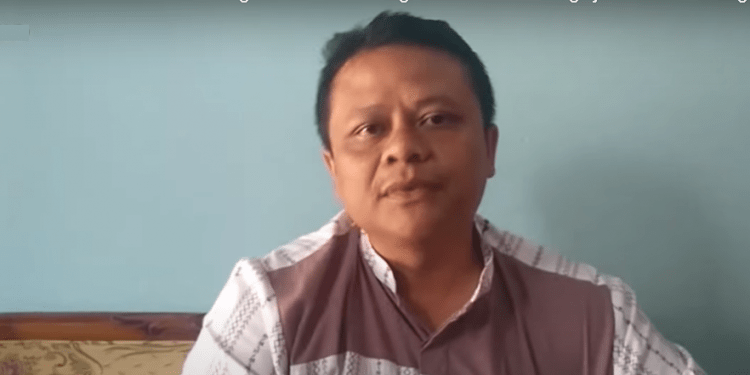
Aris Wijayanto explains the polemic faced by contract teachers. Photo: Triyo.
Similar grievances did not only come from Rahmadhiani. Gunungkidul State-School Contract Teacher Forum (FHSN) coordinator Aris Wijayanto said almost all contract teachers complained about this. “Especially during a pandemic like this,” said Wijayanto.
Wijayanto, a contract teacher at state elementary school SD Negeri Karangsari in Semin, Gunungkidul, said that there had been no assistance whatsoever from Gunungkidul regional government for contract teachers during the pandemic.
Amendments to the Ministry of Education and Culture’s Regulation (Permendikbud) No. 8/2020—the Permendikbud No. 19/2020 on technical procedures regarding the use of the School Operations Fund (BOS) was not significantly implemented.
“The purpose of Permendikbud No.19 of 2020 was to ensure contract teachers, regardless of their status, receive a living wage during the pandemic. In addition to adjusting to school needs,” complained Wijayanto.
Contract teachers with the GTT status in Gunungkidul, according to Gunungkidul FHSN data, were only eligible for mobile data allowance.
“Mobile data package is an obligation for schools because [now] the learning process is conducted via the internet,” added Wijayanto. Meanwhile, contract teachers with the ‘substitute teacher’ status and special incentive contract teachers received an additional allowance.
Before the pandemic, substitute teachers were paid Rp800,000 using funds from the Regional Budget (APBD), while contract teachers with incentive received Rp300,000 from the BOS fund. However, those with the GTT status were dependent on the school, said Wijayanto. “This is because GTT was not appointed by the Education Office and does not have a Unique Educators and Education Personnel Number (NUPTK).”
During the pandemic, substitute teachers and contract teachers with incentives could receive a bonus allowance from BOS. Substitute teachers received standard wage per the Gunungkidul Regional Minimum Wage (UMR) of Rp1.7 million. While the wage increase for contract teachers with incentives varied, the majority still received pay below the UMR.
The most challenging luck seemed to fall on contract teachers with the GTT status. According to Wijayanto, there was no willingness from the school and assertiveness from the Education Office to improve the welfare of contract teachers. “It is clear that the Permendikbud No.19 of 2020 erased NUPTK so that teachers with any status can be paid through the BOS fund, including GTT,” he explained.
But in fact, according to FHSN data, no school had implemented this breakthrough. “If before the pandemic, schools and the Education Office argued that the regulation forbade them from using the BOS fund to pay GTT teachers. Now the regulation allows them to, but still, they are not doing it,” explained Wijayanto.
The FHSN also found that contract teachers had no health insurance coverage. Meanwhile, according to Wijayanto, many of them had to do home visits and, therefore, at risk of being exposed to Covid-19 infection.
Wijayanto gave an example of himself, who had to do a home visit for five of his students. “So, for example, if I am infected with Covid-19, what should I do? With my mediocre wage and no health insurance,” he said. Even though his workload was the same as any civil servant (PNS) teachers in general, their rights were different.
The school or Education Office did not even provide them with personal protective equipment (PPE) such as face masks. Wijayanto regretted the school’s and the Gunungkidul regional government’s attitude that disregarded the safety of contract teachers. “When it should be provided by the school or Education Office now with the lax [budget] regulation,” Wijayanto added.
The Budget Transparency Puzzle
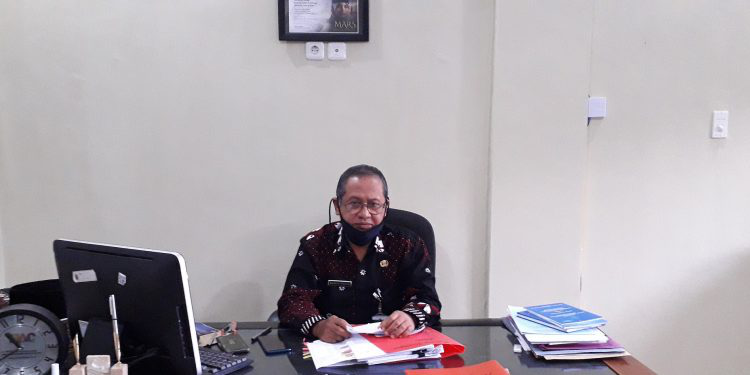
Bahron Rasyid in his office on Thursday, July 16. Photo: Triyo.
Head of Gunungkidul Education Office Bahron Rasyid explained that the BOS management was thoroughly carried out by schools following the applicable regulation. “Regarding Permendikbud No.19 of 2020 on BOS technical guidelines that removed NUPTK [requirement] for contract teachers’ honorarium is under every school’s authority,” Rasyid told jurnalgunungkidul.com on Thursday, July 16 in his office.
For this reason, he continued, the Education Office could not intervene. “We have created a socialization forum for the Permendikbud No.19 of 2020, and that is enough,” said Rasyid. Regarding GTT contract teachers, Rasyid gave it up entirely to the school even though they were under his Office’s auspices.
On the revised Gunungkidul regional budget to adjust to the 2020 pandemic situation, Rasyid said that there was no budget for PPE for teachers regardless of their status. There was not even special health insurance for contract teachers, even before the pandemic.
“The budget for the Education Office from the APBD was cut. We can’t budget all kinds of things,” explained Rasyid. The Education Office’s budget was down by Rp27 billion from Rp669 billion to Rp641 billion in the revised APBD for the pandemic.
Suryana, the Principal of SD Negeri Mentel 2 state elementary school where Rahmadhiani taught, explained why his school did not utilize the Permendikbud No.19/2020 for GTT. “Together with the School Committee [we have set] a separate budget for GTT. Aside from not wanting to take risks if something goes wrong,” Suryana explained from his office.
Even though he admitted that the wage for GTT in his school was far from appropriate, Suryana believed that the profession was an opportunity for teachers to do charity. “Apart from that, the small wage is an encouragement for GTT to continue to serve,” he added.
Regarding health insurance and PPE for contract teachers conducting home visits amid the pandemic, Suryana said they had no budget for it in the BOS fund. “For [healthcare] there is none, for PPE, I think the teachers can work on it themselves,” he said.
Chairperson of SD Negeri Mentel 2 state elementary school committee Wasito said GTT was paid from a weekly student contribution. “The contribution is pooled every Friday by the home teachers, [each student donates] at least Rp2,000,” Wasito explained in his house, which was located less than one kilometer away from the school.
Every month, an average of Rp1 million was collected. “10 percent of the donation goes to the School Committee’s petty cash and the rest we give to the school for contract teachers’ wages,” kata Wasito. Regarding the status of the teachers that were paid using the donation money, Wasito said that he did not know.
He realized that what the School Committee was doing with the donation money could be seen as a prohibited illegal levy. However, according to him, that was the only way to keep the school in his hometown running. “Our school is short on teachers, and we have been waiting for [state-appointed] PNS teachers, but nothing came through,” Wasito complained.
Wasito’s effort was then modeled by other schools. He said that the shortage of teachers also happened in different schools, and to meet the gap, they started hiring GTT. “Mid-2019 last year, I was invited by a forum for school committees at the district and subdistrict level to explain our school’s donation model as a pilot for other schools,” said Wasito.
When asked about donations during the pandemic, Wasito said none because the students were learning from home. Regarding GTT’s wages during the epidemic, Wasito said, “We have not talked about this with the Principal.”
Rasyid also could not elaborate on the transparency of GTT wages during the pandemic. Especially with what was happening at SD Negeri Mentel 2 when the School Committee was not collecting donation, and the Principal did not budget them in the BOS funds. “We just found out [about it] and will need to evaluate,” he said.
Chaotic Educational Personnel Governance
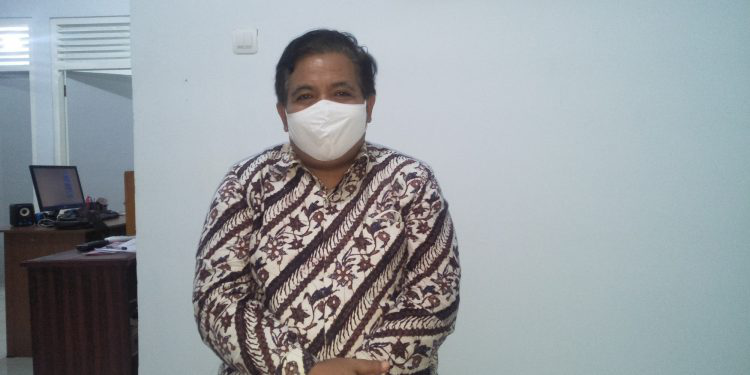
Budhi Masthuri in his office during an interview on academic staff management. Photo: Triyo.
According to Wijayanto, there were many cases similar to SD Negeri Mentel 2. “Gunungkidul FHSN cannot find comprehensive data on GTT as yet because only the schools have it,” said Wijayanto. This, according to him, was prone to abuse. “I once met a GTT who was paid from BOS fund listed as a ‘goods purchase’ item,” Wijayanto explained.
Only contract substitute teachers and contract teachers with incentives were registered, and therefore, their data could be accessed. “There are 5,700 contract teachers at elementary and junior high school levels in Gunungkidul. But this number does not include GTT,” Wijayanto explained, adding that there were only 800 substitute teachers and the rest were contract teachers with incentive.
Gunungkidul FHSN’s central demand was a decent legal umbrella for contract teachers. “Through the legal umbrella, contract teachers will have a stronger stance in claiming their rights,” said Wijayanto. Without a legal umbrella, the employment status of contract teachers in the local government would always be weak and neglected.
Head of the Yogyakarta chapter of the Indonesian Ombudsman, Budhi Masthuri, explained the vulnerability of contract teachers standing in regional employment. “Not only in Gunungkidul, in every area the problems are similar,” Masthuri said in his office on Tuesday, July 21. He referred to Law No. 5/2014 on State Civil Servants (ASN).
In the law regulating ASN, the status of contract employment was not recognized. “There are only PNS and government employees with work agreement (PPPK),” Masthuri explained. The status of contract employees was already prohibited by Government regulation No. 48/2005 and its amendment No. 43/2007.
He also explained that the shortage of teachers could not be solved by government regulation. “From the PGRI [Indonesian Teachers’ Association] 2019 data, we are short of one million teachers nationally,” said Masthuri. Not surprisingly, he continued, employing GTT was the most common solution used by schools as the smallest scope to meet these shortcomings.
Because, according to Government Regulation No.19/2017 on Amendments to Government Regulation No. 74/2008 regarding Teachers, this was allowed. “Indeed, the laws regarding educational personnel are very confusing. On the other hand, there are restrictions on the appointment of contract employees, but there are regulations that indirectly allow it,” Masthuri explained.
Responding to Gunungkidul FHSN demand on a legal umbrella for contract teachers, Masthuri considered it misplaced. “In Gunungkidul, there is a Decree by the Social Office on Substitute Teachers. The Decree itself is derived from Government Regulation No. 19 of 2017. But in reality, the basic rights of substitute teachers are still not being met,” Masthuri added.
Bureaucratic reform, according to Masthuri, would be critical to the chaotic problems in education workforce governance. “Everything needs to return to the Law No.5 of 2014 on ASN,” Masthuri said. The Law stipulated that there are only two types of educators in state schools, PNS and PPPK. Wherein the rights and responsibilities of the educators can be evaluated appropriately, aside from having more systematic and orderly management of education personnel.
The problem, according to Budhi, was the political will of the regional government. If there is a political will, the local government only needs to appoint existing contract teachers as PPPK according to the applicable regulations. “Therefore, the problem of contract teachers does not need to be this complicated, regardless of the condition, including when the pandemic strikes,” Masthuri concluded.
Author: Triyo Handoko/D02
*This article was published in Bahasa at JurnalGunungkidul.com in August 2020
This article was supported by funding from UNESCO and AJI Indonesia


