



Independen -- The Sekato Jayo farmers group in Lubuk Mandarsah village, Tebo district, had been in conflict with pulpwood supplier PT Wirakarya Sakti (PT WKS)—a sister company of APP (Asia Pulp & Paper) Sinar Mas group and one of the world’s biggest paper producers, since 2007. During the Covid-19 pandemic, the conflict was re-ignited.
The farmer's community in the village hopes that it could be resolved soon. They have requested the government to protect them so that they could go back to their livelihood.
This story is made possible by the Journalism Fellowship on Guarding Transparency & Accountability in Covid-19 Pandemic Response organized by AJI Indonesia and UNESCO.
***
In the blistering afternoon sun, Ahmad had just walked a few meters on his plot of land when his footsteps suddenly stopped. His gaze saddened as he showed the rows of jengkol (dog fruit) plants that had newly been planted in Rinting hill, Lubuk Mandarsah village, Tebo district, Jambi.
“I am still sad, my jengkol plants died, they are dry,” said the 40-year old man while showing a dried-out rows of 30-centimeters tall jengkol trees.
Ahmad could not hide the distressed look on his face. Because, he said, the jengkol seedlings of the Sekato Jayo farmers group came from government aids. But before they fully-matured, a drone belonging to PT WKS had flown over the field and sprayed herbicide.
“I had just planted 200 jengkol and durian trees, 40 trees were sprayed and trampled on. Not to mention other vegetable plants over there are dead too,” Ahmad told Kilasjambi.com during a visit to his field in mid-July.
Surrounded by his ruined crops, Ahmad shared his chronology of the day when the drones came. Incidentally, he was on location at the time. After finding out that the drones were spraying herbicide for weeds, he and several farmers immediately ran towards the drone operator and asked him to stop.
The drones at that time were flown 15 meters high, Ahmad said, sometimes slithering even higher in the air. The company drone’s herbicide spray also fell on other productive crops belonging to Ahmad’s colleagues, who was also a member of the Sekato Jayo farmers group.
“We want no conflict. But now look, our plants are dying. They’re turning yellow, later they will rot. Maybe they used a large dosage for the weeds,” Ahmad continued.
The conflict between local farmers and PT WKS had been going on for a long time, and there had been a series of disputes before. The conflict peaked again during the pandemic. The offensive actions by the company during the Covid-19 epidemic were a threat to the farmers, as well as a threat to their family’s food sustainability.
Instead of providing farmers with the opportunity to grow their own food crop, PT WKS wiped out productive agriculture—a source of food for the community.
PT WKS spokesperson Taufik Qurachman claimed that the herbicide spray was a Pre-Planting Spraying (PPS) to condition their land for industrial crops in their concession area. “We realize that this was a new method using drone technology. But we still give precedence to Standard Operating Procedures (SOP) that prioritize safety and accuracy,” said Qurachman.
His company always strives to promote dialogue to reach a common understanding with the other concerned parties. Besides, Qurachman also claimed that PT WKS upholds all applicable laws and regulations in resolving conflicts between the company and the farmer groups.
However, what happened on the field was inversed to the company’s claim. In fact, various kinds of criminalization were still often experienced by farmers. Following the herbicide spray incident, Ahmad was reported to the police for encroaching on the acacia forest. Ahmad cooperatively came to Tebo police station and explained that he was planting on his own land, which was his due. Furthermore, Ahmad said, there were no acacia trees.
“Until now, the company never drop the charge. I demanded a copy of my investigation report, but no result. [Police said] I am not a suspect,” Ahmad continued.
On April 28, another farmer, Agus, was tending his garden when he was approached by two well-built people and security personnel claiming to be “messengers” from the company. Agus did not budge even when he was rebuked by the messengers. “Suddenly, [someone] fired two shots in the air,” said Agus.
The company had also parked two units of heavy equipment around the community’s land. Sekato Jayo farmers group chairperson M. Jais assumed that the company was deliberately trying to provoke the farmers.
The heavy equipment was only operated for two hours a day, Jais continued. “They trampled our crop, [in itself] a despicable act. They were deliberately parked there to incite our anger. Inviting us to do damage to it,” said Jais. “But we are not going to do anything. We know it’s a bait. If we do something to it, they would report us [to the police], and we have to face legal consequences.”
In addition to the intimidations, the herbicide spread meant that the farmers lost a period of harvest and reap nothing from their hard work. They had to suffer both material and labor losses.
Based on the calculations by the Sekato Jayo farmers group with the Indonesian Forum for the Environment (Walhi) Jambi, the company drone’s herbicide spray had destroyed two hectares of farmers’ crops.
“The farmers who lost their crop suffered millions of rupiah in damages, not to mention the loss of labor,” said Jais.
According to him, the farmers have reported their losses to the company. But so far, they have not received any compensation. “The damaged crops belonged to pak Surbakti, pak Halim, and Ahmad,” kata dia.
Jais said that the farmers' group he headed has the right to work on a 1,500-hectare area. The land, he said, that was the customary land of Lubuk Mandarsah village, entrusted by the local customary group to the Sekato Jayo farmers group to be cultivated into agricultural fields and plantations.
“In 1985, my parents opened a farm here,” he added.
Despair Over Loss of Harvest
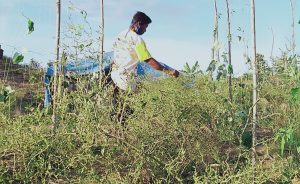
Ahmad showed the rows of dried out chili plants after a drone belonging to PT WKS sprayed herbicide over the community’s land. (kilasjambi.com/Gresi Plasmanto)
Ahmad set out to take me to another land owned by his friend Surbakti, a stone’s throw away from his own. He showed a variety of crops such as chili and watermelons on the half-hectare land. “They are also affected by the company’s herbicide spray,” he said while pointing at the rows of chili plants.
The leaves on the rows of dozens of chili stalks were dying, the stalks bore no fruit. Even though according to Ahmad, it was supposed to be peak harvest time for the chili crops.
But alas, the farmers’ hope to collect their agricultural produce was no more. Not only chilies, but the watermelon plants in the field were also gone too. A hut covered with blue tarp nearby the ill-fated chili crops where Surbakti used to rest while tending his garden lay abandoned.
“During [the herbicide spray], the wind blew to the west here. It spread everywhere. It hit our vegetable crops here. Chilies, watermelons, katu [star gooseberry], and bananas,” Ahmad said miserably. “We are devastated. What should we harvest? Everything is dead.”
Small farmers like Ahmad and the others admitted that they were significantly disadvantaged by the company. Moreover, they rely on the farm not only for their food supply but also for their livelihood. They often sold their crops to vegetable vendors or along-along in the local language. The along-along would then take their produce to be sold to neighboring villages in baskets on their motorbikes.
The Covid-19 pandemic had affected their agricultural sector, Ahmad said, especially now that their crops withered and failed because of PT WKS. Those who had lost their crops had to survive by picking and collecting vegetables that grow on swamps around their fields.
“We who lost our crops because of the herbicide are now collecting kale, genjer [yellow velvetleaf] that grow in the swamp. There are lots of genjer here. We can cook them, and if there is a lot, we can sell them,” said Ahmad.
The herbicide spray had not only affected farmers and their crops, but also the honey bee colonies nesting in the Sialang trees [wild honey trees] not far from the spraying zone.
In the location, there were four large Sialang trees like the Sialang Kedondong. “Usually, there are up to tens of hives. But now the bees are gone, [we] cannot harvest the honey,” said Ahmad.
Members of the Sekato Jayo farmers group really hope that their conflict can be resolved soon. They hope that the government can give them protection. Their only request was to live peacefully and comfortably by farming, and not to be disturbed.
“We want no intimidation when we are farming so that we can harvest the result. When farmers plant something, they also expect they can live from it,” Ahmad continued.
Food sovereignty for Jambi’s 3.6 million population had been a severe problem. It was an irony that they still need to “import” food from other regions.
With its 50,160 square-kilometer lands, Jambi had to rely on other areas to fulfill their daily sustenance. Food production from local farmers could only meet 60 percent of the province’s food demands.
“40 percent of all basic needs in Jambi are still supplied from outside the province,” said Acting Head of Jambi’s Industry and Trade Office (Disperindag) Rosnifa.
“For chili commodity, Jambi still relies on Java. [The region] also imports vegetables such as from Curup [Bengkulu], and West Sumatra,” Rosfina continued.
Lack of Transparency in Conflict Resolution during the Pandemic
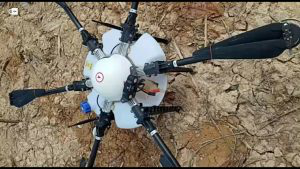
The drone that was used by PT WKS. (doc. Sekato Jayo farmers group)
Indonesia was still in a pandemic. Criminalization and intimidation against local farmers continued, including the agrarian conflicts involving the Sekato Jayo farmers group in Jambi. On April 10, PT WKS used a drone to spray herbicide on the farmers’ crops.
The Covid-19 pandemic had also brought global communities to a potential food crisis. The Food and Agriculture Organization (FAO) had issued an appeal to all countries, including Indonesia, to be careful in responding to the pandemic.
Until the end of July, the number of confirmed positive Covid-19 cases in the country had reached 108,376. The number of patients who died due to the virus reached 5,131 people. In Jambi, the province had recorded 162 infections. From this number, 115 people had recovered, and four had died.
The central and local governments have to apply measures to ensure that the people’s basic needs are met, and a food crisis during the pandemic can be averted. But another problem is that instead of providing farmers the opportunity to work on their crops, various criminalization occurred and ousted productive agricultural land.
For members of the Sekato Jayo farmers group at Lubuk Mandarsah village, cultivation is their profession. They grow crops, and the result becomes their daily provision. However, the farmers in that village have not received justice. The state does not recognize their lands.
During the Covid-19 pandemic, farmers could not freely cultivate, plant, and harvest crops. They have not received their land rights to produce their own food sources through food crops. The farmers' group was increasingly marginalized due to intimidation or violence from the company’s security team.
The forms of intimidation, criminalization, and destruction of farmers’ crops experienced by the Sekato Jayo farmers group, Lubuk Mandarsah village, were very ironic. Indonesian Forum for the Environment (Walhi) Jambi’s Executive Director Rudiansyah said that amid the global pandemic, all parties should work together and ease each other’s burden.
Rudiansyah regretted the arbitrary actions taken by the company during the pandemic.
According to him, in the current pandemic situation, it is evident that there is near-sightedness from the government in responding to the food crisis gap. So far, the local government still thinks that the region’s food sustainability still dependent on other areas.
The spirit of the government, whether it was at the central or local level regarding food sovereignty, Rudiansyah said, was not translated well. “The government should have determined the functions of sustainable agricultural areas to increase their productivity. But in fact, governments tend to turn a blind eye to the actions taken by corporations to destroy the agricultural stability,” said Rudiansyah.
He viewed that criminalization against farmers is a form of the government and the company’s lack of transparency in resolving conflicts that occurred during the pandemic. The government, according to Rudiansyah, has been silent and has allowed the community’s agricultural areas to be threatened by corporate actions.
“This is real. From the uproar of the farming community, there has been no real action by the government in the field,” said Rudiansyah. “In the end, the government knows, but they cannot do anything about it.”
APP Sinar Mas’ FCP (Forest Conservation Policy) Commitment Failure
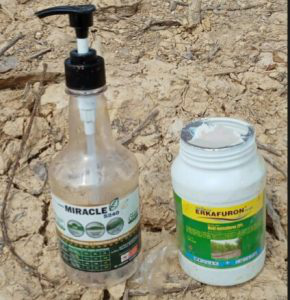
The herbicide used by PT WKS. (doc. Sekato Jayo farmers group)
The herbicide spraying incident by a drone owned by PT WKS (APP Sinar Mas Group) had moved community coalitions to defend the farmers. A total of 90 national and international civil society organizations had come together and written to APP Sinar Mas investors and buyers.
According to the coalition, the company’s way of resolving their conflict with the community can endanger the local society’s livelihood, especially amid the Covid-19 pandemic situation.
The coalition was also aware that this was not the first for the company. PT WKS once acted haphazardly against the Lubuk Mandarsah farmers group. In 2015, a group of security personnel employed by the Industrial Plantation Forest (HTI) concession holder under APP Sinar Mas was involved in the murder of farmer activist Indra Pelani.
Pelani’s body was covered in stab wounds and trauma from blunt objects. He was found about 8 kilometers from the village center. An investigation carried out by Walhi Jambi and a coalition of NGOs found that his death was deliberately planned by five company security officers. The five people have received their sentences.
After Pelani’s murder, the company was subjected to customary fines by the local community. The company also made an agreement with the locals, which, in essence, meant that they would not interfere with each other. “But the company did not keep their words,” said Rudiansyah.
Based on a study by the Environmental Paper Network (EPN) and an NGO coalition, Lubuk Mandarsah was one out of 107 farmers group that has suffered from an active conflict with the paper and pulp giant since 2007. However, until now, there has been no conflict resolution.
In fact, in 2013, APP Sinar Mas had made a commitment—dubbed as the Forest Conservation Policy (FCP), to respect the local community’s rights and conduct its business responsibly. Unfortunately, since then, various problems still occurred.
Walhi Jambi’s Executive Director Rudiansyah said that what happened between the company and the people of Lubuk Mandarsah was proof of the failure in conflict resolutions and changes in their business conducts, as has been claimed by APP Sinar Mas to the global community all this time.
“In the letter that we sent to their investors and buyers, we asked them to not do any business with APP and or its affiliated companies until it is proven that they have fulfilled their promises as committed in their 2013 FCP,” said Rudiansyah.
Meanwhile, PT WKS Public Relations Taufik Qurachman was reluctant to respond to the letter sent by the NGO coalition. Taufik only sent a link to a press release by APP Sinar Mas titled, “Correcting the record on allegations that APP damaged food security in the local community.” “The [press release] is there. It is our official statement,” said Qurachman.
In the press release posted on asiapulppaper.com on May 13, APP Sinar Mas denied all allegations made by Walhi Jambi. The accusations, according to the company, were misinterpretations of the facts in the field.
“We are open to involving credible and committed third parties to join the mediation process so that we can arrive at a fair and equitable resolution,” APP’s statement said.


